

Executive Summary
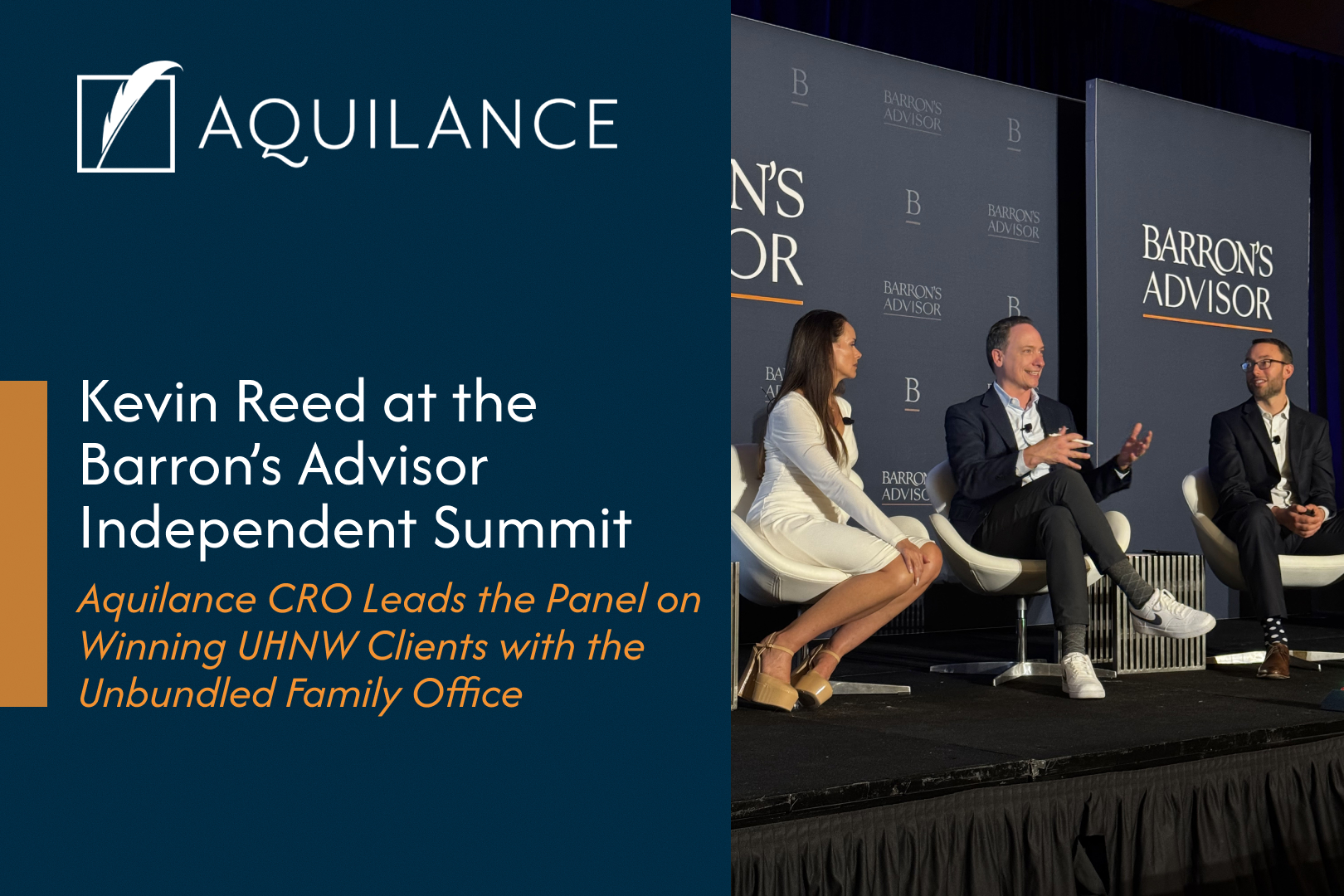
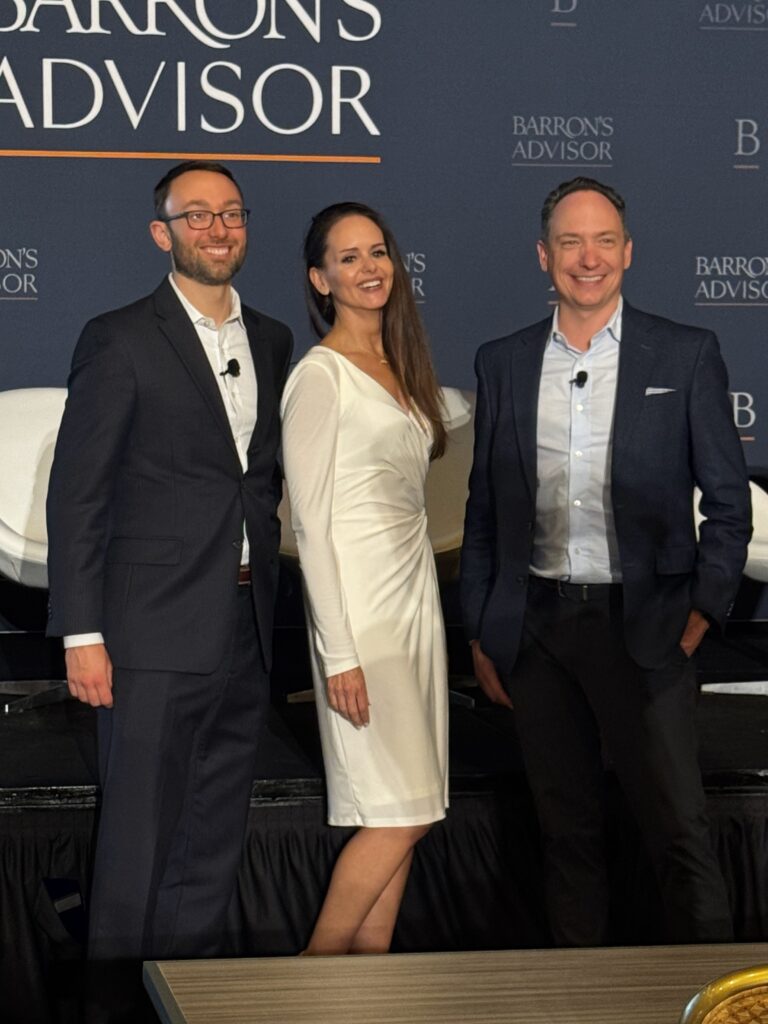
At the exclusive, invite-only Barron’s Advisor Independent Summit, Aquilance Chief Revenue Officer, Kevin Reed moderated a core panel addressing the “$10M+ Service Expectation Gap.” To bridge this gap without degrading margins, top independent RIAs are rapidly adopting the unbundled family office model. By outsourcing difficult-to-execute functions, like concierge bookkeeping and multi-entity bill payment, to specialized administrative partners, these independent fiduciaries can seamlessly deliver comprehensive financial administration support without absorbing the operational liabilities of an internal build.
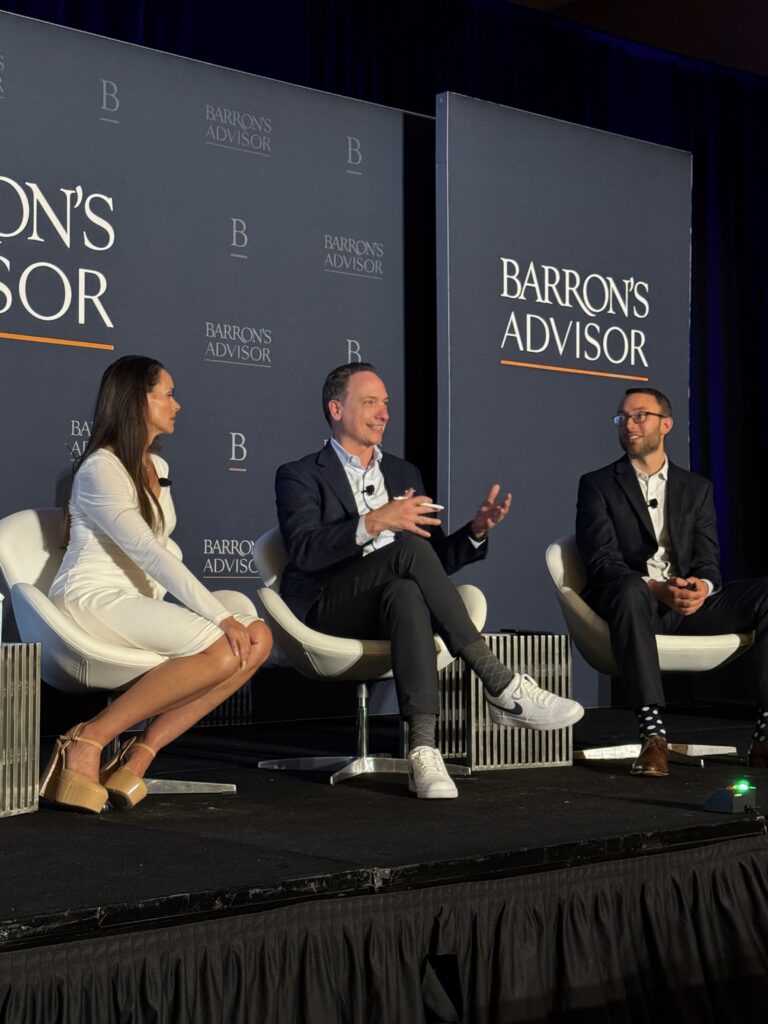
The Stage: Inside the Barron’s Advisor Independent Summit
The Barron’s Independent Summit represents a departure from standard industry trade shows; it operates as an intimate, invite-only gathering curated specifically for the most elite independent financial advisors and Registered Investment Advisor (RIA) executives in the country. Limited to a few hundred attendees, the industry’s top independent fiduciaries converge on the Summit to analyze the shifting demands of wealth management. In this environment, the discourse transcends basic capital allocation, focusing instead on the structural mechanics of scaling generational stewardship and mitigating holistic risk.
The demographic makeup of the attendees highlights a critical evolution in the independent advisory space. The professionals in the room spanned a highly strategic spectrum: from advisors who exclusively manage ultra-high-net-wort (UHNW) private clients, to highly successful high-net-worth (HNW) advisors actively seeking to expand their firm’s capabilities to service highly complex families. For this latter cohort, the primary objective is moving upmarket, which requires identifying and solving the precise administrative friction that accompanies complex estates in the $10M+ segment of clients.
The prestige of this summit is anchored entirely in its rigorous curation. Many of the RIAs in attendance operate at such an elite tier of the industry that they receive recurring invitations, returning year after year. They do not attend for basic networking; they continue to participate because they inherently trust Barron’s to curate the precise strategic, high-level content required to navigate complex market demands and better serve their top-tier clients. Consequently, the topics that capture attention in this room serve as the ultimate leading indicator for the future trajectory of independent wealth management.
“The room was near capacity for our session. We focused the entire discussion on a single strategic objective: how advisors can successfully win and retain ultra-high-net-worth relationships by deploying an unbundled family office model.”
• Kevin Reed, CRO, Aquilance
For Aquilance, holding this operational spotlight fundamentally shifted the dynamic of our firm’s presence at the event. Leading the conversation from the stage transitioned the brand from merely being another firm in the room or a vendor with a booth, to being recognized by seasoned professionals as a definitive industry authority providing a missing value. As these elite advisors grappled with the structural ceiling of their own internal capabilities, the summit provided the appropriate venue to solidify the unbundled framework as a critical mechanism for long-term RIA scale and survival.
The Panel Discourse: Defining the “Missing Piece”
At the center of Kevin Reed’s panel was a structural diagnosis of a highly lucrative, yet operationally dangerous, demographic: the $10M+ wealth tier. This specific cohort represents what Reed defined on stage as the “Service Expectation Gap”. These clients possess financial lives far too complex for standard retail wealth management, yet their asset base cannot justify the estimated $1 million annual overhead required to hire and maintain dedicated, internal family office staff, or satisfy common multi-family-office minimums. For the independent RIA, capturing this specific market share is essential for enterprise growth, but attempting to service them using legacy operational models actively destroys firm margins, limits upside, and exacerbates attrition risk.
Ultra-high-net-worth clients are seeing articles in the Wall Street Journal and the New York Times about family office services, and they are starting to ask why their current advisors aren’t offering them. Advisors should consider closing this gap now, or risk losing their top clients to private banks and wirehouses that already offer great family office solutions.”
• Kevin Reed, CRO, Aquilance
Data presented during the summit revealed the stark reality of this shifting landscape: over 60% of affluent households now explicitly expect their primary advisor to provide direct support with financial administration. Consequently, ambitious UHNW-focused advisors are aggressively attempting to shift their value proposition from a traditional “Financial Advisor” to a “Personal Family Office Executive” or “Family CFO”. However, as discussed on stage, most firms cannot successfully execute this pivot. Attempting to manage services like multi-entity cash flow reporting, household payroll, and comprehensive bookkeeping internally causes highly paid advisory teams to drown in the administrative weeds, distracting them from their core fiduciary mandate.
To solve this structural bottleneck, Reed introduced a simple framework that redefines the “Family CFO” not as a single internal hire, but as an unbundled, strategic architecture. This model is built on three pillars, starting with becoming Coordinated. Instead of acting as a siloed investment manager, the modern RIA must act as the synchronization point, bringing together the disparate, chaotic parts of a family’s life into a unified system. This requires integrating specialized, best-in, class partners.
The second and third pillars, Fractional and Oversight, are where independent RIAs reclaim their operational leverage. By utilizing fractional experts, families receive the bespoke expertise of a world, class family office without the crushing overhead of full-time employees. They scale services precisely to their needs, deploying firms like Emry Concierge for health advisory or Virtuoso for high-end travel logistics. Crucially, this unbundled structure allows the advisor to maintain ultimate Oversight. The advisor sits exactly where they belong: acting as the “Central Intelligence” of the family. By receiving high-level, structured data from these partners, such as Aquilance’s detailed cash flow reports, the advisor uses this information in quarterly meetings to drive proactive planning and fulfill their true role as the family CFO.
Case Study in Scale: Mercer Advisors and the Discipline of Outsourcing
To demonstrate the enterprise scalability of the unbundled framework, Kevin Reed was joined on stage by Jeremiah Barlow, Chief Solutions Officer at Mercer Advisors, alongside Shelby Donley, GM of the UHNW Division at Virtuoso. Under Reed’s moderation, Mercer served as the definitive operational case study for a specific reason: they are the industry’s gold standard for institutional integration. As the #1 ranked RIA in the country by Barron’s, managing over $92 billion in client assets across 90+ locations, Mercer possesses the capital and headcount to internalize virtually any function. Yet, their leadership exercises the strategic discipline to recognize exactly which high-friction tasks they should not own.
The power of the Mercer example lies in their identity as a unified “integrator” rather than a loose “aggregator”. While aggregators often struggle with disjointed back-office systems across acquired firms, Mercer operates under a single, highly disciplined service model . This model is designed to separate high-value strategy from low-value administration.
“The rule of thumb we shared with the audience is simple: if administrative or lifestyle services are not a core competency of your firm, and if you don’t see a path to them ever becoming one, you should outsource. You cannot effectively operationalize a family office experience by simply referring clients to a local bookkeeper who isn’t built to serve the RIA’s institutional needs.”
• Kevin Reed, CRO, Aquilance
Conversations from the Floor: The Market Reaction
At the Barron’s Summit, the unbundled thesis Reed presented on stage triggered alignment from the industry’s most elite practitioners. Reflecting on the strategic conversations held at the Aquilance booth, Kevin Perregaux, AVP of Strategic Client Development, noted that the most significant element of the summit was the rapid shift from conceptual agreement to procurement discussions. Rather than requiring a heavy lift to explain the firm’s value proposition, the lightbulb went off instantly for these seasoned wealth managers. Advisors explicitly stated, ‘I never knew you existed… your service is exactly what’s missing for so many people.’ These interactions rapidly bypassed standard vendor networking and evolved into urgent capability-expanding consultations.
“The immediate ‘click’ continues to surprise me. We don’t need to do a lot of heavy lifting to explain our value.The moment I described our model, the lightbulb went off instantly.”
• Kevin Perregaux, Strategic Client Development, Aquilance
The underlying theme across these floor conversations was a collective recognition of critical gaps in the UHNW client experience. Attendees at this invite, only event, ranging from advisors exclusively managing UHNW families to those aggressively scaling their capabilities for complex clients, were actively hunting for this precise missing piece. The repeating sentiment heard by the Aquilance team was not merely a polite acknowledgment of a new service, but a realization of an operational necessity. As Perregaux reported from the floor, advisors explicitly and repeatedly stated, “I never knew you existed… your service is exactly what’s missing for so many people.” These interactions rapidly bypassed standard vendor networking and evolved into urgent admissions of “we need your help,” underscoring a vastdemand within the independent RIA ecosystem.
As the summit concluded, the Aquilance team walked away both validated and energized, equipped with a highly qualified pipeline and specific, actionable reasons to engage the advisors who attended the panel. The momentum generated at this event dictates a clear, aggressive strategy for the future: to share the compounding success stories of the elite advisors who partnered with Aquilance to permanently close their client experience gap.
The Structural Dilemma: Build vs. Partner
Once an independent RIA commits to fulfilling the “Family CFO” mandate, firm leadership encounters an immediate structural dilemma regarding execution. Acknowledging the Service Expectation Gap for the $10M+ wealth tier is merely the diagnosis. The critical enterprise decision is how to solve it: does the firm build the necessary administrative infrastructure internally, or do they adopt an unbundled partnership model?
The legacy approach dictates internalizing these services to maintain absolute control. However, the economic reality of building a secure, discreet concierge bookkeeping and bill, payment division is staggering. As highlighted during Reed’s panel, creating a dedicated internal family office staff to service these highly complex clients demands an estimated $1 million in annual overhead. Beyond the sheer payroll of hiring specialized personnel(not simply administrative assistants, but complex entity bookkeepers) an internal build requires deploying institutional-grade cybersecurity to protect multi-generational ledgers. Furthermore, it forces the RIA to assume catastrophic fiduciary liability for routing complex payments. For the independent firm, this model actively compresses margins, stifles scale, and distracts leadership from asset gathering.
Conversely, the unbundled framework leverages the “Fractional” pillar of the modern CFO model. By partnering with specialized third-party fiduciaries, an RIA secures the bespoke expertise of a world, class family office without absorbing the crushing overhead of full-time staff. The firm pays only for the exact administrative capacity their clients require, scaling dynamically as the book of business grows. Crucially, the severe operational liability of daily wealth administration is legally and practically transferred to a dedicated entity whose sole focus is their core competency..
To objectively evaluate this strategic fork in the road, firm executives must weigh the following operational realities:
| Strategic Capability | Internal RIA Build (“The Legacy Approach”) | The Unbundled Framework (“The Fractional CFO”) |
| Capital Allocation | Margin-compressive ($1M/yr for dedicated staff) | Zero internal overhead; highly scalable variable cost |
| Speed to Deployment | 12-18 months of rigorous hiring, training, and integration | Immediate capability expansion and market readiness |
| Data & Cyber Security | High risk; frequently relies on disjointed consumer, grade software | Institutional-grade, centralized infrastructure |
| Advisor Utilization | Leadership and advisors drowning in the administrative weeds | 100% focus on asset strategy and acting as “Central Intelligence” |
The Next Frontier for Independent Fiduciaries
The Barron’s Independent Summit made one reality abundantly clear: solving the administrative friction of the ultra, wealthy is no longer an optional luxury for independent fiduciaries; it is a defensive necessity. As legacy wirehouses and mega-banks aggressively expand their internal concierge and lifestyle offerings to capture UHNW market share, independent RIAs face a stark expectation gap. If a fiduciary cannot offer parity in holistic lifestyle administration, they risk losing the relationship entirely, regardless of their investment acumen. The unbundled family office provides the ultimate strategic countermeasure, allowing independent firms to compete at the exact same weight class as massive institutions without compromising their independent operating structure, assuming unmanageable liability, or compressing their margins.
For Aquilance, the summit served as a validation of the market’s trajectory and the firm’s strategic positioning within it.
The market signal is clear: the demand for unbundled family office infrastructure is accelerating rapidly and Aquilance looks forward to continuing to showcase the measurable success stories of the elite advisor and RIA partners. adopting
“A sincere thank you to the team at Barron’s for getting the right advisors in the room with the right people to have these great conversations. They created an environment where attendees were encouraged to be vulnerable, drop their walls, and ask the honest questions that lead to real growth. Because of that setting, advisors were able to move past the networking and actually start solving the complex problems they’ve been feeling in their practices for years.”
• Kevin Reed, CRO, Aquilance
Frequently Asked Questions
What is the “Service Expectation Gap” in wealth management?
The Service Expectation Gap refers to the operational friction experienced when advising clients in the $10M+ wealth tier. These families possess financial structures that are far too complex for standard retail wealth management, yet their total asset base is often considered “too small” to justify the estimated $1 million annual cost of hiring a dedicated, internal family office staff. Because over 60% of affluent households now expect their advisors to support them with financial administration, failing to bridge this gap creates severe retention risk.
What does it mean for an independent advisor to act as a “Family CFO”?
Transitioning from a traditional “Financial Advisor” to a “Family CFO” requires a fundamental shift in service architecture. According to the framework presented at the Barron’s Summit, a true Family CFO operates on three pillars: they become Coordinated by bringing together the disparate parts of a family’s financial life; they utilize Fractional experts to provide world, class service without full, time overhead; and they maintain holistic Oversight, acting as the “Central Intelligence” to drive proactive planning.
Why shouldn’t an independent RIA build concierge bill payment internally?
Attempting to internalize concierge bookkeeping and bill payment requires a firm to absorb catastrophic operational liability. Beyond the estimated $1 million in annual overhead required to hire highly specialized accounting personnel, an internal build demands institutional, grade cybersecurity to protect multi, generational ledgers. Outsourcing these specific mechanics to an unbundled partner strictly transfers the risk of payment routing errors to a specialized partner, protecting the RIA’s margins and enterprise value.
How does an unbundled family office protect an RIA’s independent status?
Legacy wirehouses and private banks leverage massive balance sheets to provide in, house concierge and lifestyle management services, posing a direct threat to independent advisors. The unbundled model, where an RIA strategically partners with specialized fractional experts like Aquilance for bill pay or Virtuoso for high-end travel, allows the independent firm to achieve structural parity with these mega-institutions. The RIA offers the exact same breadth of UHNW services while maintaining its completely independent operating structure and fiduciary edge.
What is concierge bookkeeping for UHNW families?
Concierge bookkeeping goes far beyond standard tax accounting. It involves managing the granular, day-to-day administrative friction of extreme wealth. This includes multi-entity ledgering, reconciling capital calls for private equity investments, tracking K-1s, and managing payroll for private household staff across multiple properties.
How does concierge bill pay differ from standard retail banking?
Standard retail banking is designed for simple, single-household consumer transactions. Concierge bill pay involves utilizing institutional-grade infrastructure to securely route complex, multi-jurisdictional payments across intricate entity structures (such as LLCs and family trusts) while assuming the liability of exact execution and timely funding.
What types of complex entities require unbundled family office support?
Ultra-wealthy families typically utilize intricate legal structures that require highly specialized, ongoing administration. An unbundled administrative partner actively manages the meticulous ledgering and precise funding requirements for Irrevocable Life Insurance Trusts (ILITs), Charitable Remainder Unitrusts (CRUTs), Generation, Skipping Trusts (GSTTs), Family Limited Partnerships (FLPs), and multi-estate real estate holding companies.
Does an unbundled administrative partner replace the client’s existing CPA?
No. A specialized administrative partner acts strictly as the dedicated, tech-enabled execution engine. By leveraging a proprietary, institutional-grade platform operated by specialized personnel, they handle the intense daily bookkeeping and flawlessly structure the financial data. This ensures the client’s existing CPAs, estate attorneys, and wealth managers are freed from the ‘weeds’ and can perform their high-level advisory and tax mitigation work effectively.
How does solving administrative friction impact an RIA’s enterprise valuation?
As evidenced by the parity in attendance at the Barron’s Summit between sessions on UHNW retention and practice valuation, solving the client experience gap is now a primary driver of firm value. By adopting an unbundled framework, an RIA increases client stickiness, attracts highly lucrative multi, generational households, and scales AUM without absorbing margin, crushing internal overhead, all of which directly drive up enterprise multiples.
How do unbundled family office providers ensure data security and privacy?
Unlike internal RIA builds that often rely on disjointed, consumer-grade software stacks, specialized providers operate on centralized, institutional, grade infrastructure. They maintain rigorous SOC compliance and strict confidentiality protocols to protect sensitive multi, generational ledgers from cyber threats and internal fraud.
What is the first step for an RIA to implement the unbundled CFO framework?
The initial step is a targeted capability review. Advisors should audit their book of business, specifically identifying the households in the $10M+ tier suffering from severe administrative fatigue, and consult with a specialized partner like Aquilance to map out a seamless integration protocol for offloading those operational liabilities.